Softball rebounder: ready for a 12-inch ball
The FLYNX rebounder returns a regulation 12-inch softball thrown at full speed, and an 11-inch ball for younger players. Three angles give grounders, line drives and fly balls, and the yellow target square works as a strike zone for pitchers.
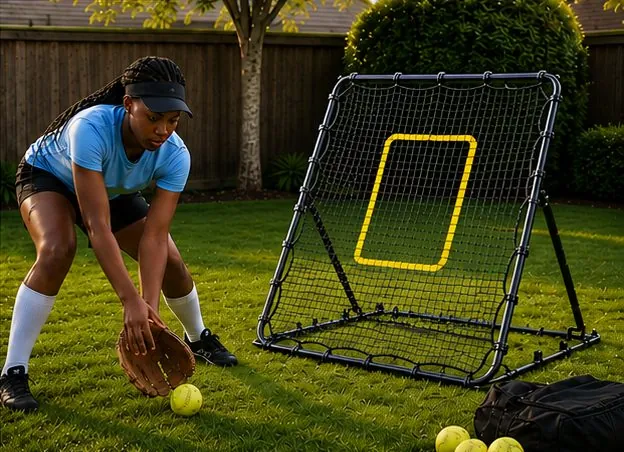
Which ball for which age
- Ages 7 to 9: a soft training ball, angles 1 and 3, an adult throwing, from 15–20 ft.
- Ages 10 to 13: an 11-inch softball, all three angles, from 20–25 ft.
- Ages 14 and up: a regulation 12-inch softball at full speed, from 25–40 ft.
Three angles, three kinds of ball
Low for grounders and short hops, upright for line drives, laid back for fly balls and pop-ups. Switching takes seconds, so one session covers infield, outfield and reaction work. More in rebound angles explained.
The drills softball players use most
- Short hops, 15 ft: throw firm and field the hop out front. Three sets of twenty.
- Backhand and forehand, 20 ft: throw a foot off-center to each side. Three sets of ten each side.
- Reaction catches, 20 ft: upright angle, catch above the eyes. Three sets of fifteen.
- Pitcher's zone, 43 ft: fastpitch pitchers throw at the target square from the high school and college distance and field the return. Three sets of ten.
The full library is on the drills page.
One net for the whole family
The same rebounder works for baseball, softball, soccer, volleyball and lacrosse, so a softball player and a baseball player share one net in the yard, under its Stars and Stripes cover between sessions.
Questions
Does a softball rebounder work with a 12-inch softball?
Yes. The FLYNX rebounder returns a regulation 12-inch softball thrown at full speed.
Can fastpitch pitchers use it?
Yes. Set the upright angle, throw at the yellow target square from 43 ft, and field the ball as it comes back.
Is a softball rebounder different from a baseball rebounder?
The FLYNX rebounder is one net for both: the same frame, angles and target square return baseballs and 11- and 12-inch softballs.