Pitchback vs rebounder: what's the difference?
They are the same thing. Pitchback, pitch back net, rebounder, bounce-back net and rebound net all name a framed net under tension that throws the ball back. What changes from one model to the next is the size, the angles, the frame, the net and what comes in the box.
Which name people use
Amazon files them all under Baseball & Softball Ball Rebounders. Baseball players and coaches often say pitchback or pitch back net; softball and soccer players often say bounce-back net. Search for any of them and you find the same kind of product.
What actually differs between models
- Size. 4 × 4.5 ft suits a backyard; 5 × 4 ft leans toward volleyball and soccer; 7 × 7 ft and up is for teams. See the size guide.
- Angles. Adjustable models give grounders, line drives and fly balls from one net. See rebound angles explained.
- Frame weight. A heavier steel frame stays where you set it through hard throws.
- The net. Ply, knots and mesh size decide how the ball comes back after hundreds of throws.
- Anchoring and cover. Ground stakes keep it planted; a cover lets it live outside.
The buyer's guide walks through each point, with the published specs of six 4 × 4.5 ft models.
Pitchback or pitching net?
A pitching net catches the ball and holds it, which suits a pitcher working through a bucket of balls. A pitchback sends the ball back, so every throw also becomes a fielding rep. With a target square, a pitchback covers both: pitchers aim at the square on the upright angle and field the return.
Where FLYNX fits
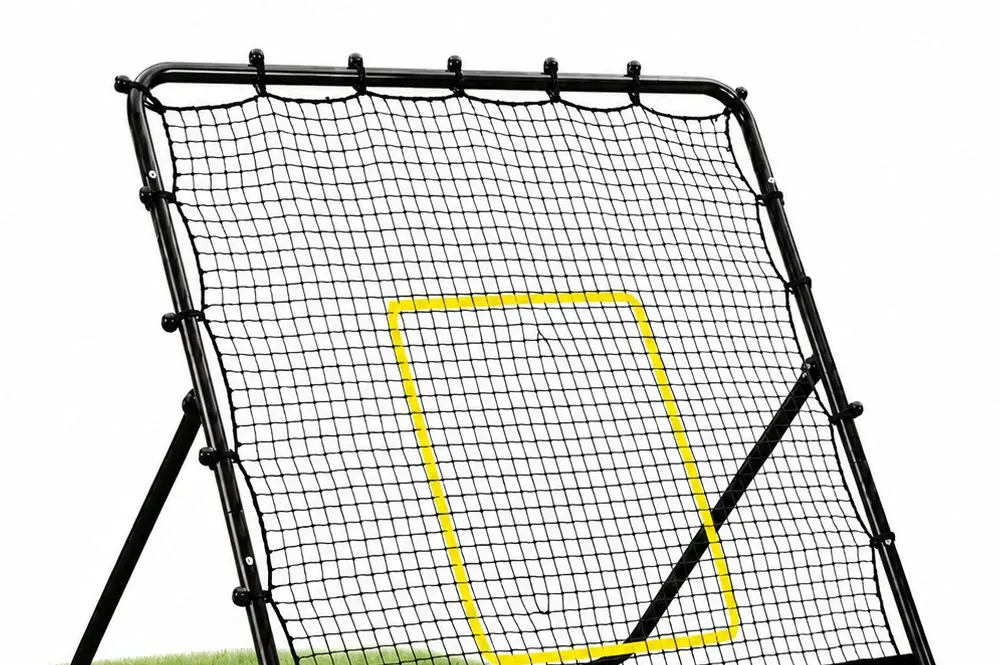
The FLYNX rebounder is a 4 × 4.5 ft pitchback with three rebound angles, a 23.5 lb powder-coated steel frame, a 36-ply knotted net held by 26 bungee cords, ground stakes, a yellow target square and a fitted Stars and Stripes cover.
Questions
Is a pitchback the same as a rebounder?
Yes. Both names describe a framed net that returns a thrown ball; bounce-back net and rebound net mean the same thing.
Can pitchers use a pitchback?
Yes. On the upright angle the ball comes straight back to the thrower, so a pitcher can work from 46 ft or 60 ft 6 in at the target square and field each return.
What size pitchback fits a backyard?
A 4 × 4.5 ft face fits most backyards and folds flat for the garage. Plan about 15 ft of space for grounders and 30 to 40 ft for fly balls and throwing.